From Democracy Now:
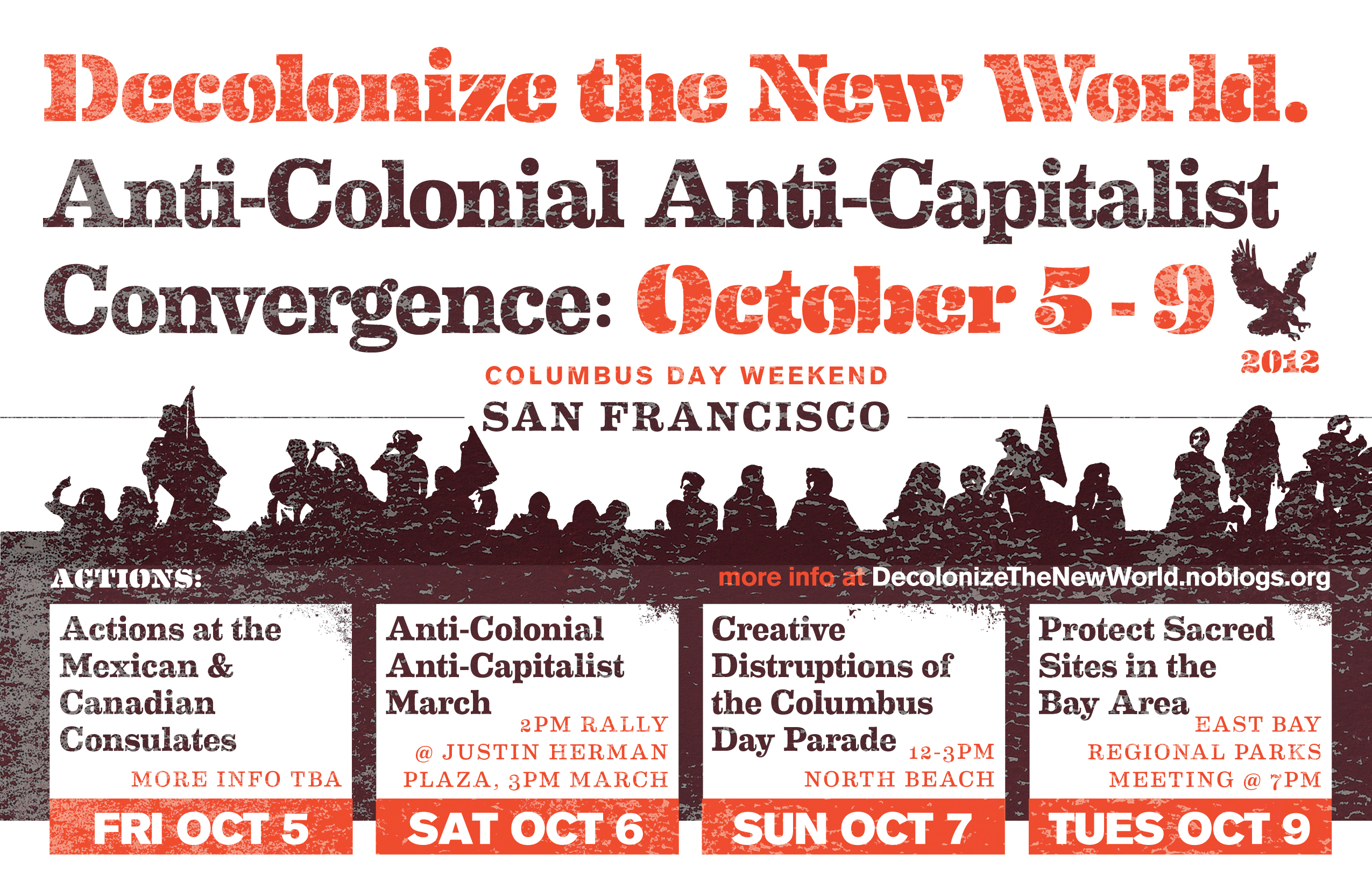
Let's celebrate a history worth celebrating: resistance.
Happy Indigenous Peoples Day!
Let's celebrate a history worth celebrating: resistance.
Happy Indigenous Peoples Day!


The arrival of the Autumn Equinox on Saturday, September 22nd, opens up a new season in our lives and within the Earth. In the Northern Hemisphere, the Equinox welcomes the newness of Autumn and the birth of Libra season. We witness the continued beautiful metamorphosis of nature shedding its summer layers and walking into its Fall. Our ancestors used this time to give thanks for the abundance from the year and gather the resources they needed to prepare for the darker and colder months This shedding process we witness in nature is a powerful keynote for us to listen to. A call to action to bring more awareness into the different layers of our lives and our communities. What will we choose to sustain? What will we choose to shed?This is a ripe moment to uncover the patterns that make up our foundation and breath new light into them. Another opportunity to recalibrate and reflect back to ourselves what we are grateful for, what needs to shift and where we need to grow. Here we can find new compasses or fix old ones, with an intention to specify and affirm the direction we want our lives to move in. We can choose to act in ways that either accept or disrupt self depricating programming, either sourced from us or from the oppressive factors around us that beg to silence us.

The first challenge is that many people don't know that they are making a choice about fragrance. It is so ubiquitous in the products we use that it comes to seem a natural part of our environment; the proverbial water the fish are swimming in. Why would people who don't have sensitivities think about this on their own? You'd be astonished if they did. So it's necessary to, first, let people know that there's a problem.This leads directly to the second challenge: a lot of people--perhaps most people hearing about this for the first time, if my experience is any indication--don't believe there's a problem even once they're told about it. I don't, in general, blame people for this. If they've never known anyone who was affected, they probably have no idea how bad it can be. I have sometimes been tempted to tap someone on the shoulder and say, "Excuse me, I need to leave now, but I wanted to let you know before I go that your decision to wear perfume to this event not only excludes me from it but means that I will probably be sick until next Thursday." But hardly anyone has ever received that shoulder tap, from me or anyone else. So they've never enountered a sufferer in the wild.Even if they believe there's a problem, and that for some people it can be quite bad, they're inclined to assume that these folks are very rare. The first time I brought up the issue of fragrance at the summer gathering, many years ago, the person I spoke to assumed that I was the only one affected, and that the problem of one person was not sufficient to merit asking 1500 people to change their behavior. In other words, the problem might be real, but it's the job of the sufferers to manage it.One friend told me that she met a woman at the gathering two years ago who was ranting about the FF policy. She thought it was just another pointless PC thing. My friend told her about me, about how hard gatherings had always been for me, and how much my experience had improved since the FF policy had started to get some traction. The woman was surprised and moved. She'd had no idea this actually mattered to anybody.I also suspect that many of us progressive types suffer from issue fatigue. We've gotten on board with "Column A: The Essential Social Issues." However imperfectly, we've embraced racial justice; gender equality; the gay and lesbian rights movement; physical accessibility for people who use wheelchairs, scooters, canes, and walkers. In addition, each of us has probably also chosen to prioritize some or all of the "optional" social issues in Column B as well: factory farming, a struggling educational system, the dismantling of voter rights, conditions for workers in overseas factories, animal rights, over-reliance on petroleum fuels, global warming, the environment, the existence of bisexuals, the bottled water industry, invasive species, and whatever else I can't think of off the top of my head.It can be very frustrating when you try to introduce the fragrance issue to the very people you think will be most open to it, and instead they resist. But I do think that resistance often comes from folks feeling like they have enough on their plate and they don't have the energy to take on one more thing.I also wonder if some of the resistance might come from a desire not to seem even more like whacked-out troublemakers than we already do. I can imagine--and this is entirely my imagination, not anything I have any knowledge of--but I can imagine the person whose job it is to talk to universities or retreat centers about our needs ranting, "I already have to tell their cafeteria staff that they have to learn to cook vegan food, turn off the ice cream machines at Wednesday's lunch, and get us re-usable cups instead of the paper ones they usually have at the beverage station. And I need to tell the facilities people that we need some of the bathrooms re-designated from Male and Female to Gender-Neutral. Now I'm supposed to tell them, what? That we want them to switch out all the bathroom soap for fragrance-free, and that they can't use their usual cleaning products in the bedrooms? Well, I sure look forward to that conversation!"Even once people decide they'd like to make some personal changes to help with this problem, there are challenges. They might not know where to find FF products for instance--though this has gotten much easier in recent years. I used to be able to use only Clinique makeup, for instance--$15 for a lipstick!--but a few years ago, when I needed to buy makeup for the first time in years for a choir concert, I was able to get cheap FF lipstick, blush, foundation, eyeshadow, and mascara at my corner Rite Aid.But people who haven't looked before may not know that somewhere in that wall of shaving cream is one brand whose "extra sensitive" product is fragrance-free, or that Common Brand Of Lotion makes a FF moisturizer you just have to read the fine print to find. It can be disorienting and overwhelming.People might also be concerned that FF products won't work as well as what they're used to. And that might indeed happen. Sometimes that's a trade-off people should just resign themselves to making (are your perfect hair and blinding-white gym socks really that important?), and sometimes it's a trade-off they can't make. I had some things to say about this previously in a post called The Hierarchy of Harm.
"While most coastal cities breathe ocean breezes mixed with traffic exhaust, people in north and central Richmond are exposed to a greater array of contaminants, many of them at higher concentrations. Included are benzene, mercury and other hazardous air pollutants that have been linked to cancer, reproductive problems and neurological effects. People can’t escape the fumes indoors, either. One study showed that some of the industrial pollutants are inside Richmond homes.
It's the triple whammy of race, poverty and environment converging nationwide to create communities near pollution sources where nobody else wants to live. Black leaders from the Civil Rights Movement called the phenomenon environmental racism, and beginning in the early 1980s, they documented the pattern at North Carolina's Warren County PCBs landfill, Louisiana's "Cancer Alley," Tennessee's Dickson County, Chicago's South Side, Houston's Sunnyside garbage dump and other places across the country.
About 56 percent of the nine million Americans who live in neighborhoods within three kilometers of large commercial hazardous waste facilities are people of color, according to a landmark, 2007 environmental justice report by the United Church of Christ. In California, it’s 81 percent. Poverty rates in these neighborhoods are 1.5 times higher than elsewhere.
Those numbers, however, reflect a miniscule portion of the threats faced by nonwhite and low-income families. Thousands of additional towns are near other major sources of pollution, including refineries, chemical plants, freeways and ports.
Richmond is one of these beleaguered towns, on the forefront of the nation's environmental justice struggle, waging a fight that began a century ago."
"While we may share some histories, it is critical for us Muslims and other non-Indigenous people here to not fall into the trap of equating the struggles of Muslims with that of Indigenous peoples in white settler colonies, where Indigenous people who have been living here since time immemorial have now been outnumbered by whites through illegal land grab, dispossession, and outright genocide. Under settler-colonialism, as Patrick Wolfe asserts, “the dominant feature is not exploitation [of Indigenous peoples’ labor] but replacement” of Indigenous people by white people.[iv] Our connection as racialized people to this land is not the same as that of its Indigenous peoples, and we have to remember that they are not just a “minority” group here, like we are. In “Heteropatriarchy and the three pillars of white supremacy,” scholar Andrea Smith explains how the logic of the genocide of Indigenous peoples and slavery, and continual treatment of Black people as property under capitalism, interrelate and work with the Orientalist logic of seeing Muslims and Arabs as inferior, which legitimizes constant war on their lands and bodies.[v] It is important, therefore, to understand the different but interrelated ways in which white supremacy affects and implicates us. My Muslim feminist praxis asks me not to leave this recognition of living on stolen land as rhetoric, as a mere admission, but rather to make my complicity into an urgent political and personal task.
How does this sense of complicity translate into an everyday feminist praxis? As a Muslim feminist, fighting racism, sexism, and homophobia has been at the forefront of my agenda. However, an understanding of ongoing colonial relations between Canadians and Indigenous peoples here makes it necessary to remember that, as several Indigenous women have patiently pointed out again and again, colonization happened precisely through patriarchal gendered violence against Indigenous women. As Smith explains in her ground-breaking work,Conquest: Sexual Violence and American Indian Genocide:[I]n order to colonize a people whose society was not hierarchical, colonizers must first naturalize hierarchy through instituting patriarchy.[vi]Drawing on these insights, I recognize that my struggles against gender violence will fail if articulated in isolation from confronting colonial patriarchal relations that continue to strengthen sexual and other forms of violence against Indigenous women, women of color, and white women. I cannot fight against the invasion of my body if my politics do not account for the ways in which Indigenous women have been constantly marked for death and disappearance. If I am angry about Mark Steyn’s anti-Muslim vitriolic cry that the “future belongs to Islam” because Muslim women are reproducing “speedily” while the Western (white) population is declining,[vii] I have to remember that Indigenous women are still seen as “better dead than pregnant”.[viii] The “Stolen Sisters” report by Amnesty International (Canada) states that a 1996 Canadian government statistic reveals that Indigenous women between the ages of 25 and 44, with status under the Indian Act, were five times more likely than all other women of the same age to die as the result of violence.[ix] Native Women’s Association of Canada reports the number of missing and murdered Indigenous women at 582 since 1980,[x] while several other Indigenous men and women report the number to be much higher, which is not surprising given the fact that colonialism works precisely through targeting Indigenous women’s bodies. If Indigenous women’s bodies are disposable and a site of everyday violence, what integrity can my body demand here?"