
Wednesday, December 21, 2011
Happy Solstice!


Sunday, December 18, 2011
V For Vendetta: Why I Liked the Movie Better Than the Book
Over the last week I read the graphic novel V For Vendetta. And as I finished it today I could not help thinking that it was not what I expected. In fact, although I know this to be highly blasphemous, on first read: I liked the movie better. I don't know that I have ever liked a movie version better than the book, so I found this revelation rather disturbing. It probably didn't help that I have seen so many fans of the book trash the movie adaptation either.
But, as I did what I usually do when something particularly troubling is bothering me (take a shower and think about it) I realized what bothered me about the book. It wasn't the violence or the more morally convoluted energy of the story or even the blunt anarchist propaganda of some passages (nothing wrong with propaganda in theory, but there was something jarring to me about it's application here), it was the individualism.
What the movie did really well was to express how V served as a catalyst, but for the overall vision to succeed it took the mobilization of people. A large mass of people. It took the community working together. It took an uprising. Surely that vision should look familiar these days, right? From Egypt to Oakland large amounts of people streaming out into the streets to oppose the powerful?
Anyway. In contrast, the book really relied on V as a spokesperson, as a LEADER, to mobilize the people. And so for all of his preaching of anarchism, V looked much more conventional to my First World eyes: the charismatic leader rallying his troops to revolution rooted in chaos and violence. I don't want to downplay the fact that he certainly was individually heroic in the movie too (maybe even "super-heroic," managing to take all those bullets and remain standing...)....but in the end the "victory" didn't rely on that, whereas in the book, it did.
Fundamentally I just don't believe that is how anarchism can succeed. This is why I am a SOCIALIST libertarian/anarchist, because I believe it takes us working together to protect each other, because I believe it takes community accountability, because I believe it takes self-awareness and openness to the needs of other people that are different from our own, to make a vision like anarchism realistic, because I believe it takes solidarity, real solidarity. (Look to the EZLN for a model that seems to be working as far as I can tell.)
In addition, the book's V required a replacement. Evey had to take up the costume to continue the work. While I get there is a sort of poetry to that (we can be/are all V!) I think it is less effective than the movie's version of this, wherein everyone in the crowd took up the mask TOGETHER, and less effective than the movie's version of Evey: who rejects V even as she loves him. She does not take up the mask, she fulfills V's last wish and then goes to build the better world. Book-Evey's taking up of the mask means she steps into his legacy and is symbolically walking in his footsteps. The people on the ground don't know this person is different from the one who started it all, and, again, maybe there is a kind of poetry in that, the duality of humanity encapsulated in one person...but it didn't work as effectively for me, that's all I know.
Because as V says in both versions: this new world has no place for him, the Destroyer. Movie-Evey's turning away from him (and what he did to her, even as she moved forward changed because of that experience and seems comfortable in her new skin) is precisely what is necessary for the new world he envisions, because there is no place for that kind of destruction in the building of a new world from the ashes of the old. In fact I found book-Evey's willingness to continue to live with and trust V after he tortured her to border on misogynistic writing.
I will say this though, I did like the book's villains better than the movie's. In the book the villains seem so average and regular, as leaders are at the end of the day: they are just people. In the movie the villains are larger than life and VERY evil. In the case of the Leader, "larger than life" is meant quite literally. Of course this is compromised by the end when he is killed, and we see that he is just human after all - so I get what the Wachowskis were doing here - but this humanity is clear all the time in the book, and that was more effective for me in showing how those in power can be worked against and overthrown. In the end, even evil people are just people, we have to come to terms with that both in the sense of realizing they are mortal, and in the fact that we are both human and that their evil might reside within us as well.
So yeah. I do know that it usually takes more than one read to absorb everything a book is doing, but this was my discomfort as I read through this first time, and I don't know that I will read it again anytime soon, but I think this was worth writing out.
But, as I did what I usually do when something particularly troubling is bothering me (take a shower and think about it) I realized what bothered me about the book. It wasn't the violence or the more morally convoluted energy of the story or even the blunt anarchist propaganda of some passages (nothing wrong with propaganda in theory, but there was something jarring to me about it's application here), it was the individualism.
What the movie did really well was to express how V served as a catalyst, but for the overall vision to succeed it took the mobilization of people. A large mass of people. It took the community working together. It took an uprising. Surely that vision should look familiar these days, right? From Egypt to Oakland large amounts of people streaming out into the streets to oppose the powerful?
Anyway. In contrast, the book really relied on V as a spokesperson, as a LEADER, to mobilize the people. And so for all of his preaching of anarchism, V looked much more conventional to my First World eyes: the charismatic leader rallying his troops to revolution rooted in chaos and violence. I don't want to downplay the fact that he certainly was individually heroic in the movie too (maybe even "super-heroic," managing to take all those bullets and remain standing...)....but in the end the "victory" didn't rely on that, whereas in the book, it did.
Fundamentally I just don't believe that is how anarchism can succeed. This is why I am a SOCIALIST libertarian/anarchist, because I believe it takes us working together to protect each other, because I believe it takes community accountability, because I believe it takes self-awareness and openness to the needs of other people that are different from our own, to make a vision like anarchism realistic, because I believe it takes solidarity, real solidarity. (Look to the EZLN for a model that seems to be working as far as I can tell.)
In addition, the book's V required a replacement. Evey had to take up the costume to continue the work. While I get there is a sort of poetry to that (we can be/are all V!) I think it is less effective than the movie's version of this, wherein everyone in the crowd took up the mask TOGETHER, and less effective than the movie's version of Evey: who rejects V even as she loves him. She does not take up the mask, she fulfills V's last wish and then goes to build the better world. Book-Evey's taking up of the mask means she steps into his legacy and is symbolically walking in his footsteps. The people on the ground don't know this person is different from the one who started it all, and, again, maybe there is a kind of poetry in that, the duality of humanity encapsulated in one person...but it didn't work as effectively for me, that's all I know.
Because as V says in both versions: this new world has no place for him, the Destroyer. Movie-Evey's turning away from him (and what he did to her, even as she moved forward changed because of that experience and seems comfortable in her new skin) is precisely what is necessary for the new world he envisions, because there is no place for that kind of destruction in the building of a new world from the ashes of the old. In fact I found book-Evey's willingness to continue to live with and trust V after he tortured her to border on misogynistic writing.
I will say this though, I did like the book's villains better than the movie's. In the book the villains seem so average and regular, as leaders are at the end of the day: they are just people. In the movie the villains are larger than life and VERY evil. In the case of the Leader, "larger than life" is meant quite literally. Of course this is compromised by the end when he is killed, and we see that he is just human after all - so I get what the Wachowskis were doing here - but this humanity is clear all the time in the book, and that was more effective for me in showing how those in power can be worked against and overthrown. In the end, even evil people are just people, we have to come to terms with that both in the sense of realizing they are mortal, and in the fact that we are both human and that their evil might reside within us as well.
So yeah. I do know that it usually takes more than one read to absorb everything a book is doing, but this was my discomfort as I read through this first time, and I don't know that I will read it again anytime soon, but I think this was worth writing out.
Friday, December 09, 2011
Review: Shadoweyes, Volume One

Shadoweyes, Volume One by Ross Campbell
My rating: 5 of 5 stars
I really enjoyed this graphic novel, the content was interesting, the story was intriguing and the characters were amazing. Not to do any spoilers but this text deals with several social issues and oppressed identities in ways I rarely see and I was impressed. Yes, the story was quick, but it seemed kinda par for the course with comics to me, and totally met my expectations. Can't wait to read Vol. 2!
View all my reviews
Tuesday, November 29, 2011
A Meditation on The Decemberists - This Is Why We Fight, and the Decolonize/Occupy Movement
While I was watching the video it just hit me really hard like, isn't the story being told (through the visuals, through the music) so much a story of the underclass choosing to stand up and just refuse to take the shit those in charge are dealing? To refuse to continue to be controlled by fear and manipulation and coercion and force and false privilege any longer?
And particularly, that those who used to be aligned with/protected by those in charge need to abandon that and stand with the oppressed?
Even so far as that it took one of "their own" being thrown out of the protective circle of the powerful group to galvanize those who revolted to their realization?
It's so bittersweet and inspiring at the same time... Just like I feel about this movement...
Saturday, November 26, 2011
Thursday, November 24, 2011
Recommended Reading on Thanksgiving
Full disclosure: yes, my family gets together on this holiday and does the turkey dinner, and we thank Spirit for what we have been given that year and wish blessings on our own and the world in the coming days. This has never been about the Pilgrims or in ignorance of the genocide that has built this country, but it does mimic the traditions passed down in the historical mythology of this settler colonial nation, and while I love this day for seeing family I don't get to see often and eating good food with them I am increasingly ambivalent about the holiday, even in the form we "celebrate" it. At the very least I think that while we are giving thanks, it is a good time to also meditate on the things in our nation and communities that need to change, the destructive and violent cycles that need to end and that (in the national mythology) we trace to this event of The First Thanksgiving.
In that spirit I share this piece, please click the link to read the full essay: Original Occupation: Native Blood & the Myth of Thanksgiving
In that spirit I share this piece, please click the link to read the full essay: Original Occupation: Native Blood & the Myth of Thanksgiving
Intro to that first occupationWe are talking widely among ourselves about “occupying” Wall Street — taking the center of an empire back for the people of the world. We are talking about “Occupy Everything” — sharing our dreams of taking all society away from banks, police, and the heartless authority of money. We hope this moment marks a beginning of the end for them.And yet, just such a moment cannot be understood without remembering that other occupation — the one that marked the beginning of their beginning.
Arrogant invaders occupied a land using the most naked forms of genocide. They invented new forms of slavery, slave trade and profit making. They arrived with their high-tech arms and bibles. They declared all was theirs by divine right, while they took it all with raw force.Put another way: That first occupation was a sweeping nightmare that starts with Columbus. It has continued for 500 years. For the Native peoples of today (and therefore for us too) it remains an ongoing story of domination and removal. The nation-state who today labels millions of indigenous descendants “illegal aliens” arrived in boats with only royal decrees and their holy book as documents of legitimacy.Every schoolchild in the U.S. has been taught that the Pilgrims of the Plymouth Colony invited the local Indians to a major harvest feast after surviving their first bitter year in New England.Here is the true story of that Thanksgiving — a story of murder and theft, of the first “corporations” invented on North American soil, of religious fundamentalism and relentless mania for money. It is a story of the birth of capitalism.This piece is intended to be shared at this holiday time.Pass it on. Serve a little truth with the usual stuffing.
Sunday, November 20, 2011
Transgender Day of Remembrance

(If anyone knows who took this photo I would love to know, a friend posted it on Facebook but they didn't know where it came from originally)
The list of the dead
Candles are lit for you tonight, sisters.
Thursday, November 17, 2011
Saturday, November 12, 2011
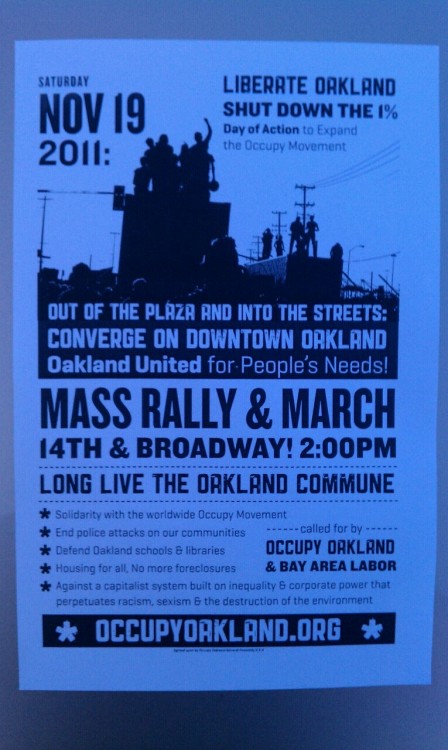
Indigenous Solidarity Teach-Ins at #DecolonizeOakland
From Facebook:
Press Release/Announcement
Decolonize Oakland (DeOccupy Oakland)
Sunday, 11/13, 5:00-6:00
Monday, 11/14, 4:00-5:00
Oscar Grant Plaza, Oakland, California
FOR IMMEDIATE RELEASE
Indigenous Solidarity Teach-Ins will explore some of the questions raised at the Occupy Oakland General Assembly on October 28 when the Memorandum of Solidarity with Indigenous Peoples passed by a 97% voting majority.
What does it mean to acknowledge the United States as a colonial and imperial nation? What is colonialism and imperialism?
What does it mean to acknowledge that Oakland is already occupied land? Who are the Chochenyo Ohlone people?
What does decolonization and deoccupation of the United States and Oakland mean? What can it mean?
Come discuss and learn with each other.
Contact:
Joanne Barker
jmbrkr62@gmail.com
Subscribe to:
Posts (Atom)