Saturday, May 23, 2020
In Memory of Stacey
Thursday, November 22, 2012
A Day of Thanksgiving: Challenging Colonialist Myth
Myth #1: “The First Thanksgiving” occurred in 1621.
Monday, October 08, 2012
On Columbus Day, Indigenous Activists Urge Celebration of Native Culture & Teaching of the Americas’ Genocide
Let's celebrate a history worth celebrating: resistance.
Happy Indigenous Peoples Day!
Friday, August 10, 2012
Important Shit I Have Been Reading: Some Reflections on Creating Fragrance-Free Space
Read it all, the author talks about not just the challenges of this issue of accessibility and large gatherings (excerpted here) but also methods of implementation and the point of the whole thing. If you don't know much about fragrance accessibility, this is a great post for learning a whole lot in a short amount of time. It's something I've been working on for the past few years, negotiating and figuring out what things are most important to get fragrance free, and where/when fragrance can still be in my life. It's a process, and it takes time, but I do think it's pretty important.
via Tape Flags and First Thoughts
The first challenge is that many people don't know that they are making a choice about fragrance. It is so ubiquitous in the products we use that it comes to seem a natural part of our environment; the proverbial water the fish are swimming in. Why would people who don't have sensitivities think about this on their own? You'd be astonished if they did. So it's necessary to, first, let people know that there's a problem.This leads directly to the second challenge: a lot of people--perhaps most people hearing about this for the first time, if my experience is any indication--don't believe there's a problem even once they're told about it. I don't, in general, blame people for this. If they've never known anyone who was affected, they probably have no idea how bad it can be. I have sometimes been tempted to tap someone on the shoulder and say, "Excuse me, I need to leave now, but I wanted to let you know before I go that your decision to wear perfume to this event not only excludes me from it but means that I will probably be sick until next Thursday." But hardly anyone has ever received that shoulder tap, from me or anyone else. So they've never enountered a sufferer in the wild.Even if they believe there's a problem, and that for some people it can be quite bad, they're inclined to assume that these folks are very rare. The first time I brought up the issue of fragrance at the summer gathering, many years ago, the person I spoke to assumed that I was the only one affected, and that the problem of one person was not sufficient to merit asking 1500 people to change their behavior. In other words, the problem might be real, but it's the job of the sufferers to manage it.One friend told me that she met a woman at the gathering two years ago who was ranting about the FF policy. She thought it was just another pointless PC thing. My friend told her about me, about how hard gatherings had always been for me, and how much my experience had improved since the FF policy had started to get some traction. The woman was surprised and moved. She'd had no idea this actually mattered to anybody.I also suspect that many of us progressive types suffer from issue fatigue. We've gotten on board with "Column A: The Essential Social Issues." However imperfectly, we've embraced racial justice; gender equality; the gay and lesbian rights movement; physical accessibility for people who use wheelchairs, scooters, canes, and walkers. In addition, each of us has probably also chosen to prioritize some or all of the "optional" social issues in Column B as well: factory farming, a struggling educational system, the dismantling of voter rights, conditions for workers in overseas factories, animal rights, over-reliance on petroleum fuels, global warming, the environment, the existence of bisexuals, the bottled water industry, invasive species, and whatever else I can't think of off the top of my head.It can be very frustrating when you try to introduce the fragrance issue to the very people you think will be most open to it, and instead they resist. But I do think that resistance often comes from folks feeling like they have enough on their plate and they don't have the energy to take on one more thing.I also wonder if some of the resistance might come from a desire not to seem even more like whacked-out troublemakers than we already do. I can imagine--and this is entirely my imagination, not anything I have any knowledge of--but I can imagine the person whose job it is to talk to universities or retreat centers about our needs ranting, "I already have to tell their cafeteria staff that they have to learn to cook vegan food, turn off the ice cream machines at Wednesday's lunch, and get us re-usable cups instead of the paper ones they usually have at the beverage station. And I need to tell the facilities people that we need some of the bathrooms re-designated from Male and Female to Gender-Neutral. Now I'm supposed to tell them, what? That we want them to switch out all the bathroom soap for fragrance-free, and that they can't use their usual cleaning products in the bedrooms? Well, I sure look forward to that conversation!"Even once people decide they'd like to make some personal changes to help with this problem, there are challenges. They might not know where to find FF products for instance--though this has gotten much easier in recent years. I used to be able to use only Clinique makeup, for instance--$15 for a lipstick!--but a few years ago, when I needed to buy makeup for the first time in years for a choir concert, I was able to get cheap FF lipstick, blush, foundation, eyeshadow, and mascara at my corner Rite Aid.But people who haven't looked before may not know that somewhere in that wall of shaving cream is one brand whose "extra sensitive" product is fragrance-free, or that Common Brand Of Lotion makes a FF moisturizer you just have to read the fine print to find. It can be disorienting and overwhelming.People might also be concerned that FF products won't work as well as what they're used to. And that might indeed happen. Sometimes that's a trade-off people should just resign themselves to making (are your perfect hair and blinding-white gym socks really that important?), and sometimes it's a trade-off they can't make. I had some things to say about this previously in a post called The Hierarchy of Harm.
Monday, January 16, 2012
Tucson school district bans books by Chicano and Native authors
The decision to ban books follows the 4 to 1 vote on Tuesday by the Tucson Unified School District board to succumb to the State of Arizona, and forbid Mexican American Studies, rather than fight the state decision.
Students said the banned books were seized from their classrooms and out of their hands, after Tucson schools banned Mexican American Studies, including a book of photos of Mexico. Crying, students said it was like Nazi Germany, and they were unable to sleep since it happened.
[...]
"the last time a book of mine was outlawed was during the state of emergency in apartheid South Africa in 1986, when the regime there banned the curriculum I’d written, Strangers in Their Own Country, likely because it included excerpts from a speech by then-imprisoned Nelson Mandela. Confronting massive opposition at home and abroad, the white minority government feared for its life in 1986. It’s worth asking what the school authorities in Arizona fear today."
Indeed [emphasis mine].
Banned books include:
Rethinking Columbus: The Next 500 Years
The Tempest (yes, the Shakespeare play)
Pedagogy of the Oppressed
Occupied America: A History of Chicanos
The House on Mango Street
Black Mesa Poems
The Devil’s Highway
Like Water for Chocolate
Ten Little Indians
The Lone Ranger and Tonto Fist Fight in Heaven
Ocean Power, Poems from the Desert
...And many more, apparently.
Yeah.
Despite knowing that book banning is NOT new to America, it still makes my blood boil (or at least it feels like it's boiling...).
I mean, really, when has banning books EVER led to or been a part of anything good? Isn't "our freedom" why we've been told "the terrorists hate us"? How can the same people who spout that line not see how fucking un-free actions like this are?
Oh, that's right, because they are hypocritical "Libertarian" assholes who think everything is ok as long as it's the US doing it... We're special fucking snow flakes that way.
Wednesday, January 11, 2012
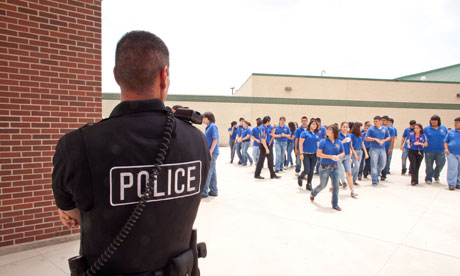
Must Read: "The US schools with their own police"
From The Guardian
A few highlights:
The charge on the police docket was "disrupting class". But that's not how 12-year-old Sarah Bustamantes saw her arrest for spraying two bursts of perfume on her neck in class because other children were bullying her with taunts of "you smell".
"I'm weird. Other kids don't like me," said Sarah, who has been diagnosed with attention-deficit and bipolar disorders and who is conscious of being overweight. "They were saying a lot of rude things to me. Just picking on me. So I sprayed myself with perfume. Then they said: 'Put that away, that's the most terrible smell I've ever smelled.' Then the teacher called the police."
In 2010, the police gave close to 300,000 "Class C misdemeanour" tickets to children as young as six in Texas for offences in and out of school, which result in fines, community service and even prison time. What was once handled with a telling-off by the teacher or a call to parents can now result in arrest and a record that may cost a young person a place in college or a job years later.
"Zero tolerance started out as a term that was used in combating drug trafficking and it became a term that is now used widely when you're referring to some very punitive school discipline measures. Those two policy worlds became conflated with each other," said Fowler.
Children with disabilities are particularly vulnerable to the consequences of police in schools. Simpkins describes the case of a boy with attention deficit disorder who as a 12-year-old tipped a desk over in class in a rage. He was charged with threatening behaviour and sent to a juvenile prison where he was required to earn his release by meeting certain educational and behavioural standards.
"But he can't," she said. "Because of that he is turning 18 within the juvenile justice system for something that happened when he was 12. It's a real trap. A lot of these kids do have disabilities and that's how they end up there and can't get out. Instead of dealing with it within school system like we used to, we have these school police, they come in and it escalates from there."
According to the department's records, officers used force in schools more than 400 times in the five years to 2008, including incidents in which pepper spray was fired to break up a food fight in a canteen and guns were drawn on lippy students.
Chief Brian Allen, head of the school police department for the Aldine district and president of the Texas school police chiefs' association, is having none of it.
"There's quite a substantial number of students that break the law. In Texas and in the US, if you're issued a ticket, it's not automatically that you're found guilty. You have an opportunity to go before the judge and plead your case. If you're a teacher and a kid that's twice as big as you comes up and hits you right in the face, what are you going to do? Are you going to use your skills that they taught you or are you going to call a police officer?"
Read it all, there were too many priceless quotes to pull them all out.
Thursday, November 24, 2011
Recommended Reading on Thanksgiving
In that spirit I share this piece, please click the link to read the full essay: Original Occupation: Native Blood & the Myth of Thanksgiving
Intro to that first occupationWe are talking widely among ourselves about “occupying” Wall Street — taking the center of an empire back for the people of the world. We are talking about “Occupy Everything” — sharing our dreams of taking all society away from banks, police, and the heartless authority of money. We hope this moment marks a beginning of the end for them.And yet, just such a moment cannot be understood without remembering that other occupation — the one that marked the beginning of their beginning.
Arrogant invaders occupied a land using the most naked forms of genocide. They invented new forms of slavery, slave trade and profit making. They arrived with their high-tech arms and bibles. They declared all was theirs by divine right, while they took it all with raw force.Put another way: That first occupation was a sweeping nightmare that starts with Columbus. It has continued for 500 years. For the Native peoples of today (and therefore for us too) it remains an ongoing story of domination and removal. The nation-state who today labels millions of indigenous descendants “illegal aliens” arrived in boats with only royal decrees and their holy book as documents of legitimacy.Every schoolchild in the U.S. has been taught that the Pilgrims of the Plymouth Colony invited the local Indians to a major harvest feast after surviving their first bitter year in New England.Here is the true story of that Thanksgiving — a story of murder and theft, of the first “corporations” invented on North American soil, of religious fundamentalism and relentless mania for money. It is a story of the birth of capitalism.This piece is intended to be shared at this holiday time.Pass it on. Serve a little truth with the usual stuffing.
Friday, April 01, 2011
We Are One: April 4 Day of Action
Beginning with worship services over the April 1 weekend, and continuing through the week of April 4, unions, people of faith, civil and human rights activists, students and other progressive allies will host a range of community- and workplace-focused actions.
Join us in solidarity with working people in Wisconsin, Ohio, Indiana and dozens of other states where well-funded, right-wing corporate politicians are trying to take away the rights Dr. King gave his life for: the freedom to bargain, to vote, to afford a college education and justice for all workers, immigrant and native-born. It’s a day to show movement. Teach-ins. Vigils. Faith events. A day to be creative, but clear:
Friday, March 04, 2011
Rally Against Gang Injunction TODAY March 4 in Oakland
*****PROGRAM******:
In addition to listening to organizers of all ages from all over Oakland, including Angela Davis, speak out against gang injunctions, there will be theater and performances (Including Boots Riley from The Coup) at the rally. Free Childcare will be provided*
OUR STRUGGLES ARE LINKED: fighting against the injunctions throughout the state of California is directly linked to fighting for affordable housing, more jobs, better education, free, relevant and empowering programs for youth and formerly incarcerated people, and free health care. As money and resources are squeezed out of the basic services our communities need for survival, health, and sustainability, money continues to be funneled into institutions of social control, like policing and imprisonment. As part of this trend, gang injunctions specifically have been used throughout the United States since the late 1980's as a major suppression tactic by police forces (over 30 injunctions were enacted in Los Angeles County alone from 1993-2000). Gang injunctions have been enacted in Sacramento, San Francisco, San Jose, and Orange County.
Fighting injunctions is a local, statewide and national issue.
How You Can Support:
* If you/your organization is located outside of Oakland, please come to town and/or holler at us for support in getting here.
* Announce these events at any upcoming meetings and invite members of your organizations in person, by email, text, facebook and every other means possible.
* If you work with young people or in schools, you can help expand our Day of Education on Wed March 2nd by talking about the injunctions with your students/participants (Contact us for more information).
By working together we can stop the spread of gang injunctions in our
communities!
FOR MORE INFO, EMAIL US: stoptheinjunction@gmail.com
Saturday, January 15, 2011
"Sex" is not an "adult" activity
In fact, the idea that sex is ONLY for adults is something that is really pervasive in U.S. culture. We often use "adult" as a stand-in for "sexual," and in most states the "age of consent" is 18, which is our arbitrary decision of when people become "adults."
Before that threshold, apparently, we can't legally be trusted to make important decisions for our lives; our parents, in fact, know better than us what we need. (That idea is worthy of a whole other post but if you're interested there's good writing on it going on here, here [of this fame] and here, just to name a few.)
And so we take for granted this idea that "sex" is something that adults, and only adults, do. Or at least, we take that as the *BEST* way. Most people I know are *resigned* to the fact that children do things like masturbate, have sexual fantasies and desires, and have sexual experiences with a partner or partners. But see, even they, most of the time, are resigned to that fact. This is something that happens, though it isn't the *ideal.* This is why even comprehensive programs of sex ed stress abstinence, because "childhood" abstinence is held up as the ideal.
Even so, I'm now starting to think I lived in the golden age of sex education in USian public school, given the reports coming out of the high schools in my area NOW as compared to when I went to school (a whopping 9 years ago)... And even in my classes, sex was presented as something we should probably avoid, but if we didn't, here, we'll help protect you from the dangers. And of course, dangers they actively protected us (white, suburban, middle class, Californian us, for the most part) from were: pregnancy and STD's.
This approach is what made me want to write my own damn curriculum. Because (among other things) do you know, we never discussed consent? Weird, huh?
(Again...a whole other post...)
(And did we ever consider or include non cis, non hetero classmates? Um, no.)
But see, we never discussed consent because one of the foundational ideas of the courses was that "well, we're not going to teach kids HOW to have sex!"
(Oh gods how many times I've heard that phrase.)
And therein lies the origin of my problem.
This idea that sex is something that only adults do means that we are consistently resistant to anything that smacks of "teaching our kids HOW to have sex".
What does that mean to the lives of all those who are under 18?
And hell, even 18 and older, because after 18 years of being taught "this is something we don't talk about" we don't suddenly become comfortable talking about it; let's be real on that point.
So what happens is we end up in a situation where, most people, come to this place where we WANT to have sex and we have no idea how to even begin to go about it. How do we talk to someone about this thing we're not supposed to talk about? Maybe it's easier just NOT to talk about it, eh? We can like, just go for it, right? If they don't want to be kissed or touched they'll slap us or say no, right? (That's how it goes in the movies.)
Surely you see where this all leads right?
Which is why we have to, HAVE TO, tell kids HOW to have sex, and stop thinking that sex isn't something non-adults are curious about, thinking about, desiring, and, doing.
Because healthy sexual relationships (at whatever age, in whatever form) aren't built in silence.
Because we need a healthy foundation to make good decisions for ourselves.
And because, ironically, if you aren't teaching kids how to communicate honestly, you're also actively working against their ability to articulate boundaries, to "just say no" which is what so many of you want, right?
Thursday, December 30, 2010
Rant rant rant
You know, people talk about how always “having discussions with people who agree with you” is some kind of bad thing. And they don’t usually even apply it to like, “people who agree with you on EVERYTHING” (ARE there any of those??) but just seem to mean “people with similar political/social philosophies”.
Increasingly, I’m like, fuck that.
It’s so fucking FRUSTRATING having conversations with people who aren’t at least on a similar wavelength. It’s the SAME FUCKING CONVERSATION OVER AND OVER!
Explaining the same basic shit over and over and arguing about it!
Explaining that racism is a systemic thing. Explaining that gender isn't just what your doctor assigned to you. Explaining that violence is something beyond just violent crime statistics. On and on....
It’s me, well in this case me, fucking giving that person an education they don’t fucking appreciate and me never getting anything out of it but honing my rhetoric.*
Deepest, best, most challenging conversations I’ve EVER HAD were with people with SIMILAR foundations/starting points discussing the nuances and challenges and YES DISAGREEMENTS we had about topics.
FACT.
And you know, I could use more of THAT and less of this frustrating bullshit.
*With the exception of people with whom I am mutually invested through friendship. Because that also invests us in trying to understand where the other is coming from, something the conversations I'm talking about generally totally lack. And that investment is, I think, similar to what you have between people who are working towards/from a similar place as you.
Saturday, October 02, 2010
School Stuff: My Current Research Projects
So, I'm guessing if you're still here you might have some interest in what I'm doing while I'm away. Well, I had to turn in my three research project proposals recently, so I thought I'd share and let you see what I've been and will be working on...
First up...
I'm taking a class on Raza Women. For my additional project I'm going to read the book Desert Blood by Gaspar de Alba and discuss how the book intersects with what we've been discussing during the semester. As the book is on the Juarez femicides I'm guessing I'll be talking a lot about Latinas and violence; you know, happy stuff! Am pretty sure I'll find myself having to critique the book for ignoring trans Latinas, but, I'll hope for the best until proved wrong. Still, I'm planning to have to do supplemental research to talk about that in the paper.
Second...
The project I am proposing is one that will require me to research the Wizard Rock community and genre. I plan to do this through primarily internet research and the podcast WZRD, as well as by looking for documentation/discussion in film and print. The final project will consist of a paper of 15 double-spaced pages sharing my findings and analyzing them within the context of the course and our discussions of gender, race and class in popular music. It is also likely, should time permit, that I will analyze one or two songs by a Wizard Rock artist(s) as Sheila Whiteley does at times in her book.
Already since turning this project proposal in I have found in preliminary research that I might end up talking about "filk" (genre focused folk music) initially as a precursor to wrock, and that thinks like trock (TARDIS rock, aka Dr. Who themed rock music) also exist. Might have to inform her of changes as I turn more stuff in on the schedule she (professor) laid out for me.
and Last...
For my research project during this term I would like to analyze three episodes of science fiction television and their portrayal of Indigenous people; specifically, “The Paradise Syndrome” from Star Trek, “Journey’s End” from Star Trek: The Next Generation, and “The Blessing Way” from The X-Files. While the primary “object” of investigation in this project would be the way these episodes deal with race, I would approach the subject from an intersectional perspective, analyzing the way in which gender, sexuality, ability and other axes of identity as well as structures/issues of power, such as colonialism and Whiteness, complicate the projects of these episodes and their impact on the audience. At this time the questions I have are rather basic; “how are indigenous people portrayed in these episodes?” and “how have such portrayals changed over time?”
Thoughts are, of course, welcome.
Friday, September 10, 2010
Martin Luther King Jr. Quote and a Memory of Ignorance
I'll never forget the day I had to tell a "room full" of people (it was online) that this was a basic tenant of civil disobedience. That, yes, civil disobedience meant breaking laws on purpose and that yes this was a foundational part of MLK Jr.'s philosophy for the Civil Rights movement (which he got from Gandhi) (never did manage to work Bayard Rustin or basically the more complete story at all into it because, well, I couldn't even get them to go with me on the very basic fact that Gandhi and MLK had the audacity to decide they had an obligation to disobey unjust laws).One may well ask: How can you advocate breaking some laws and obeying others? The answer lies in the fact that there are two types of laws: just and unjust. I would be the first to advocate obeying just laws. One has not only a legal but a moral responsibility to obey just laws. Conversely, one has a moral responsibility to disobey unjust laws.- Martin Luther King Jr.
I used this very quote to prove my point when they flatly refused to believe me.
Even now, looking back on it, I'm stunned at the ignorance. Just what the fuck did they learn about this man and the Civil Rights movement in school/growing up, that they missed this???
And, wow, how thoroughly has the kyriarchy managed to sanitize his story and legacy, eh?
Friday, June 18, 2010
Medical Sexual Assault of Children at Cornell
Bad Vibrations | Bioethics Forum
For over a decade, many people (including us) have criticized this surgical practice. Critics in medicine, bioethics, and patient advocacy have questioned the surgery’s necessity, safety, and efficacy. We still know of no evidence that a large clitoris increases psychological risk (so is the surgery even necessary?), and we do know of substantial anecdotal evidence that it does not increase risk. Importantly, there also seems to be evidence that clitoroplasties performed in infancy do increase risk – of harm to physical and sexual functioning, as well as psychosocial harm.
But we are not writing today to again bring attention to the surgeries themselves. Rather, we are writing to express our shock and concern over the follow-up examination techniques described in the 2007 article by Yang, Felsen, and Poppas. Indeed, when a colleague first alerted us to these follow-up exams – which involve Poppas stimulating the girls’ clitorises with vibrators while the girls, aged six and older, are conscious – we were so stunned that we did not believe it until we looked up his publications ourselves.
Can You Hear Us Now? | Psychology Today
Finally, do we really think this is like what happened in the Tuskegee Syphilis Study? Yup. A population gets marked as being not normal sexually, and then ends up as research fodder with sub-standard ethics oversight, without anyone even telling them they're research fodder. The docs publish years of follow-up studies in medical journals, and their colleagues, including the medical journal editors, don't stop and say, "Wait, what now? What are you doing?" And the only way these girls are going to get protected is if the press finally gets involved.
We Need to Talk About IGM... | bird of paradox
Consider: the report states that the subjects had enlarged clitorises, and that this anatomical variation “is often a prominent manifestation of virilizing congenital adrenal hyperplasia and other disorders of sexual development”.
Congenital adrenal hyperplasia(CAH) is an endocrine disorder in which the adrenal glands produce abnormally high levels of virilising hormones and as such is already known to the medical profession as an intersex variation – or “disorder of sexual development, the preferred pathologising and stigmatising term which, although preferred by the medical profession, is objected to by some intersex activists.
It seems increasingly likely to me that, not only are we talking about a research project on intersex children, but also that that fact is being suppressed in Dreger and Feder’s article
Saturday, May 22, 2010
Senior Seminar Project.
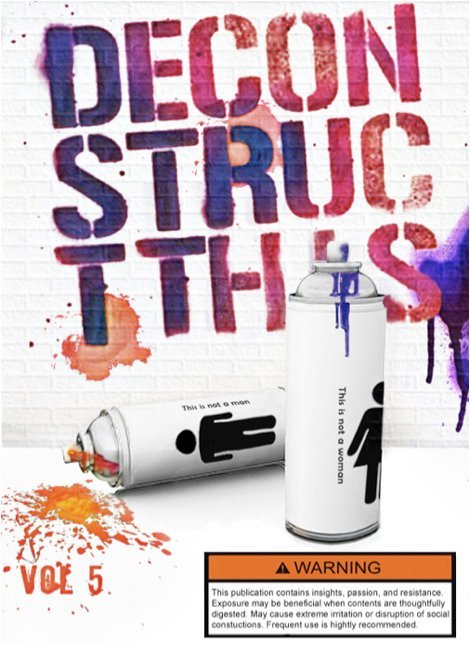
Women and Gender Studies at SFSU's Photos - Deconstruct This, Volume 5
The 2010 Senior Seminar is pleased to announce the publication of Deconstruct This! volume 5. If you would like a copy, either stop by HUM 315 or, if you are off-campus, contact the department office to have one mailed to you.Wooooooot! I put a buttload of work into this thing... I was a head person on the layout team and then this is also what the collaborative sex ed piece I shared with y'all a while ago was for. Overall I'm pretty happy with the final product. There are some really excellent pieces in it.
Sunday, April 18, 2010
Sexuality Education Workshop - Any Thoughts Welcome
OK so what I've got for you today is this workshop outline I'm doing with a colleague for the zine our senior class will publish at the end of the semester. I'm not exactly sure why I felt called to this project but I really, really, did and the woman I'm working with on it has been a pleasure to work with so it's just been good all around.
It is still, majorly, in a formative state (I'm also compiling a resource list which is not included below). In other words, this is not at all our final draft. I am putting it up here for constructive criticism and feedback, because I want it to be as good as it possibly can be! Also, I know that both my partner and I have similar privileges (for example, both cis, pretty much white and middle class) which we can not really check each other on, AND this is a similar concern for the people I have immediately around me in class.
So anyway, without further ado...
You Will Probably Have Sex Someday
What am I reading?
Following is a brief and tentative outline of our intended layout and key points for a sex-positive sexuality education workshop which would last about 3 hours. This outline/guide is primarily intended for audiences who already have some grasp of gender and sexuality studies, with the understanding that confusing elements for the students involved in the workshop could be addressed and explained during class time. Some aspects of the outline would need to be tailored specifically for each individual audience, for instance, to make the workshop culturally relevant, or to address the specific laws of the state/county the workshop is being held in. Finally, you will find that under some discussion points there will be a number of questions, if these are not addressed directly in the section below it is because we recognized that these may be discussed in more than one section of the workshop, or that the answers might alter slightly depending on the class context, and have left these options open for more flexibility.
Why did we create this workshop?
We think it is very important for people to have non-judgmental access to accurate information about sex and sexuality. We are troubled by the way some organizations have approached this topic and believe a lack of accurate information reproduces oppressive and unequal relationships. We believe that a person’s sexuality and sexual expression are unique and that each individual should feel they are in control of their sexuality/gender expression. We hope that our presentation will contribute to your developing a secure sense of self during a turbulent time.
Who is this workshop for?
We have created an outline for a sex positive sex education workshop catered to sophomores in high school. This is done with an understanding of their developmental location, as well as a cognizance of their likely life experiences and social interactions and relationships. Our intention is to provide and equip 14-16 year olds with the knowledge and tools they need to help develop their own understandings of their bodies, their sexualities, and their gender identities, as well as to facilitate future healthy relationships in their lives.
We want to avoid current and past practices of shaming and silencing issues around sex and sexuality to create a more open, honest, and accurate place for teenagers to acquire, interact with and apply information.
1) Who are we? (10 min)
2) Terms you should know (20 min)
Þ Sex: a category assigned at birth based on your secondary sexual characteristics. People born with an organ recognized by the doctors or midwife as a penis will be assigned “male” and people with an organ recognized as a vulva/vagina will be assigned “female.” People with ambiguous genitalia are considered “intersex” and often doctors will recommend surgery to “correct” that baby’s ambiguous sexual organs so that they may be assigned a “proper” sex. This surgery has sometimes even been done without parental knowledge/consent. Your assigned sex is commonly understood to determine your gender (though this is inaccurate).
Þ Gender: socially accepted/expected behaviors, personal traits, and physical appearance commonly recognized as “male/masculine” or “female/feminine.”
Þ Cisgender: someone who identifies with the sex/ gender they were assigned at birth.
Þ Transgender: someone who does not identify with the sex/gender they were assigned at birth.
Þ Genderqueer: someone who does not identify with or perform one socially accepted gender.
Þ Sexuality: behaviors, attractions and beliefs related to sexual feelings and expression.
3) Relationships (we all have them!) (30 min)
Þ As we’re sure you already know there are many different types of relationships a person will have with others throughout their lifetime; relationships with family, with acquaintances, with friends, and for many people, eventually relationships that involve sexual desire.
Desire is an emotion everyone feels and it is not always sexual in nature. In addition, the form it takes, and specifically what persons or behaviors are desired will vary widely from person to person. It is good to pay attention to your own feelings of desire because they can help tell you what you do and do not want out of a relationship with another person. This is important to know so that you can talk openly with your partner about what you are and are not comfortable with in the relationship (whether that relationship is romantic or not).
What you are or are not comfortable with can be described as the “boundaries” of the relationship. Boundaries can be everything from how often you both spend time just with each other versus separately or together with your other friends, to whether you will practice monogamy, to whether or not you want to be sexually active and what exactly “sexually active” will mean for you.
It is with this last example in mind that we have put together this workshop, to provide you with information so that you might feel comfortable making informed choices about your bodies and what you do with them, and the tools to communicate these desires to your partner(s). We realize that this sort of open communication is often not encouraged by authority figures and peers, that often people who “know too much” about sex are looked down upon, but we believe it is vitally important to understand desire and sexuality so that you can determine and set your own relationship boundaries.
Þ Consent: What is it? What are the laws about consent? What is enthusiastic consent?
o In this context, “consent” means an agreement to engage in a sexual activity. All people have the right to decide whether or not they will engage in sexual activity.
o The only form of valid consent is an enthusiastic “Yes” to each and every activity! “Maybe”, “wait”, “not yet”, “I’m not sure”, silence from your partner, or any other sign of hesitation on their part should all be understood as simply “no”. In addition, consent to one activity should never be taken as consent to any other activities!
Þ Rape and Abuse: What is rape? How is rape legally defined? How do I make sure I never rape someone? Can men be raped? Is it true if I dress “sexy” or flirt with someone that I have to have sex with them? What is date rape? What is sexual harassment? What is “sexual silence”?
o Rape is when someone is physically forced, threatened with physical force, or otherwise coerced into performing a sexual act they do not wish to. This can happen to anyone.
o “When either partner isn't given or allowed to have an equal voice, or when one voice or person is dismissed or silenced, we are usually looking at abuse. When one partner chooses not to treat another with respect and care for their physical, emotional and sexual health, well-being and safety, it is abuse.”[i]
o Resources: www.sexlaws.org contains information on your local laws.
http://www.rainn.org/ Rape, Abuse and Incest National Network, 1800-656-HOPE 24/7
http://www.scarleteen.com/article/crisis/dealing_with_rapehttp://www.scarleteen.com/article/crisis/blinders_off_getting_a_good_look_at_abuse_and_assault
____________________
Break (20 min)
_________________
4) STI’s and Birth Control (the stuff EVERYONE covers!) (20 min)
Þ Prevention: condoms/dams/gloves (brief overview)
Þ Birth control: condoms/HBC/natural family planning (brief overview)
o How/where to get testing for STI’s, pap smears, HBC, condoms, abortion (local laws and reference to local clinics with emphasis on sex positive, queer/trans friendly care).
5) Bodies (we all have these!) (30 min)
Þ People’s bodies look differently from each other; there is a lot of normal variety in how people look and function, both in their faces, body types, ability, height, weight and sex organs.
o It’s important to feel comfortable in your own skin, as impossible as that may sound to you right now, during a time when everyone is judging everyone else for the way they look. Try not to judge yourself, that your body keeps you alive is, in of itself, amazing.
Þ Functions: Periods and Emissions (milestones for people with uteruses or penises)
o Period devices (cloth pads, disposable pads, tampons, menstrual cups)
o Discharge: http://www.scarleteen.com/article/body/honorably_discharged_a_guide_to_vaginal_secretions
Þ Gender: Most people feel uncomfortable with some or all of the expectations placed on us by others because of our gender. Maybe you are a girl and hate the dresses your parents want to put you in. Maybe you are a boy and hate sports. That boys love sports and girls love dresses are gender stereotypes and do not fit all cisgender men and women.
o Sometimes, this discomfort goes further than these examples. Maybe your parents tell you that you are a boy, but you know they are wrong and you are in fact a girl, or vice versa. It is possible you are transgender. Sometimes this can be confusing, other times it is not at all. Being transgender is also a normal bodily configuration! It is especially important for all cisgender people to understand this, because often transgender people meet with violence from cisgender people who are afraid of them.
6) Sexuality (the good stuff) (30 min)
Þ Sexual expression
o When engaging in partnered sex some people have a strong preference for certain types of bodies (gay, lesbian, straight) and some people do not (pansexual, bisexual), this is normal.
Þ Sex
o Many people have sex, but some people don’t like to; both are ok!
o Masturbation – A fun, common & healthy activity, though, no, not “everyone” does it.
o Sex toys – Can be used during masturbation or partnered sex as accessories.
§ Rubber vs. Silicone & safety.
o Partnered sex - Many people have varying sexual fantasies and desires, which is why communication is so important.
o Pleasure – Center mutual pleasure in any sexual activities.
o Lube – Important and useful, for instance when using condoms so they feel good and are less likely to break.
o Porn – Some people like it, some people don’t, be aware that this is entertainment and should not necessarily be used as a template for enjoyable sexual activities, communicating with your partner about likes and dislikes is a more effective strategy than copying pornography!
7) Q&A – Answer questions from box and raised hands (30 min)
Þ Questions should be being sorted while other person is speaking in previous sections
Wednesday, March 24, 2010
Thinking Out loud About a School Project...
So I've been sitting here a few hours looking through posts I could use to build at least a portion of the presentation focusing on the feminist blogosphere and the way it replicates all the same problems that feminism has always been a part of and that it is not a utopia, etc. (Was thinking about talking about the Amanda Marcotte fiasco, either around that immigration article she wrote in 2008 or shortly after what happened with her book).
But you know I kind of don't feel all that good about it?
And so I thought to myself that perhaps it would be better just to focus the whole presentation on the gaming community (which is the other subject we decided to dedicate part of the class time to), maybe on interesting stuff about the construction/performance of gender like what is in this article: http://www.eludamos.
But you know I kind of don't feel all that good about that either? About just giving up on what I wanted to do?
I mean... we're in a feminist department and our topic is "internet communities and blogs" and I really think that their is some interesting stuff that goes on in the feminist/womanist blogosphere that relates directly to work we're going to be doing soon as "feminists" (in quotes cuz I don't know that we all identify that way) going out into the world, that I don't see being talked about in academia that much, and I don't know that I want focus on the negative (maybe it's too easy? maybe it's just already been done? I dunno)... instead wouldn't it be nice to focus on the positive and the creative for a change?
But you know, like, I threw a topic like that out there (radical love) (something I'd only come across online although on some research it looks like it goes back to bell hooks?) and no one bit and I don't think should just find a way to bully my way into getting to talk about it anyway.
So, I dunno, I just feel kind of stumped. Which is why I'm writing, to try and think through what I might do... And if any of you out there have any ideas, I'd love to hear them.
One thing I've been thinking about is maybe talking about Arwyn's essay "Dancing Through the Tables" as her analysis is another thing I've never run into in academic feminist circles? Or maybe Harriet's "Another Post About Rape," because I think it deals with what happens in the non-academic world with policy really well? And also I think that probably a lot of us will go into some kind of public service and way too many of us don't grapple, I think, with the fact that we might just not be able to stand some of the individuals we work with and we need to ask ourselves if we're capable of helping every one who might cross our paths. So yeah... that's the best I got so far. There's just so much to choose from. o.O
Sunday, March 07, 2010
Racism on UC Campuses
A firestorm over racially and ethnically charged incidents at several University of California campuses spread Tuesday as UC San Diego announced a KKK-style hood was found on campus and students in Los Angeles and Irvine demonstrated against intolerance.LA Times
"What kind of campus promotes an environment that allows people to think it's acceptable to target people for their ethnicity, gender or sexuality?" said Corey Matthews, one of about 200 mostly minority UCLA students who held a lunchtime rally. "It's something about the tone of the environment that allows this."
At UC Irvine, about 250 people gathered for a "student solidarity speakout" to condemn the recent spate of racist incidents at UC San Diego that targeted black students and another incident last month at UC Davis, which targeted a Jewish student with a swastika carved on her door, said Marya Bangee, an event organizer.
The protests came on the same day UC San Diego announced the discovery of a white pillowcase fashioned into a KKK-style hood — the third racist incident around the campus in as many weeks — and a day after UC Santa Cruz officials found an image of a noose scribbled on the inside of a bathroom door.
Officials found the hood, which bore a hand-drawn circle and cross, on a statue of children's book author Theodor Geisel, aka Dr. Seuss, outside the main campus library late Monday. A rose had been inserted between the statue's fingers.
Detectives were analyzing the pillowcase for fingerprints and DNA evidence, a university statement said.
UC San Diego Chancellor Marye Anne Fox vowed to punish the culprits to the fullest extent of the law. "We will not tolerate these despicable actions," she said in the statement.
The hood came on the heels two other UC San Diego incidents: a February off-campus, student-organized "Compton Cookout" party that mocked Black History Month with ghetto stereotypes; and a noose found hanging from a library bookshelf last week.
This shit has got to stop.
Thursday, March 04, 2010
Statewide Day of Action
*Update* To keep up to date on the happenings today in California (and in other states apparently?) check out this site: http://cbs4.com/national/California.students.protest.2.1538101.html
You can also follow my Twitter feed as I have been updating sporadically throughout the day.