Showing posts with label environment. Show all posts

Saturday, April 05, 2014

Connect the Dots: Refinery Corridor Healing Walks


If you are in the Bay Area I'd definitely recommend checking this out!

Connect the Dots: Refinery Corridor Healing Walks:
The Connect the Dots: Refinery Corridor Healing Walks is a series of four walks along the San Francisco Northeast Bay refinery corridor. The refineries include: Shell, Tesoro, Valero, Phillips 66 and Chevron. Each refinery community suffers from high rates of cancer, asthma and autoimmune diseases.

Join us for one walk or all four between April and July, 2014. Rallies will be conducted at the beginning and end of each journey.

Walk solo, in a group, or relay the walk with your friends. The first walk is about 15 miles. Water will be provided, please bring snacks.

Bring your friends and family! The beginning rally of Walk #1 on Saturday, April 12th will be at the Pittsburg Marina at 9:00 a.m. will feature a speaker from Idle No More SF Bay and local residents. The ending rally at 5:30 p.m. at Waterfront Park in Martinez will be about what we envision for the best possible future for our communities. Maps of the walk route are below. For more information go to: ConnectTheDotsHealingJourneys.org or call (510) 619-8279 or email refineryhealingwalks@gmail.com

If possible, please make your own arrangements to get back to the starting point if your transportation is there. A shuttle will be available but it will take time to go back and forth.

Taking BART? Email us at: refineryhealingwalks@gmail.com
for pick up at 8:30 a.m.

Everyone is invited to join us on these healing walks as we journey along the refinery corridor. We will pray for life, the waters, soil, air, safety of the refineries and their workers, and a just transition beyond fossil fuels. We are all in this together and it's time to envision a better future for our communities.

Humanity exists within a finite system of air, water, soil and life. This is all we have. It is time for humanity to come together to ensure a safe future beyond fossil fuels. All of the tools for this transition are already available. Several times a month there is some type of fossil fuel disaster in the news. Life, soil and water are damaged every time this happens. We must come together to mold the future we want beyond fossil fuels. The time is now and it is up to us. It is obvious that the fossil fuel corporations don't care about us. Our future is in our hands. Join us to create it!

WHEN
April 12, 2014 at 9am - 6pm
WHERE
Pittsburg Marina, Pittsburg, California USA
51 Marina Blvd
Pittsburg, CA 94565
United States
Google map and directions
CONTACT
Gathering Tribes · refineryhealingwalks@gmail.com · (510) 619-8279

Friday, August 10, 2012

Important Shit I Have Been Reading: Some Reflections on Creating Fragrance-Free Space

Also file under: "stuff I haven't talked about that much but should."

Read it all, the author talks about not just the challenges of this issue of accessibility and large gatherings (excerpted here) but also methods of implementation and the point of the whole thing.  If you don't know much about fragrance accessibility, this is a great post for learning a whole lot in a short amount of time.  It's something I've been working on for the past few years, negotiating and figuring out what things are most important to get fragrance free, and where/when fragrance can still be in my life.  It's a process, and it takes time, but I do think it's pretty important.

via Tape Flags and First Thoughts
The first challenge is that many people don't know that they are making a choice about fragrance. It is so ubiquitous in the products we use that it comes to seem a natural part of our environment; the proverbial water the fish are swimming in. Why would people who don't have sensitivities think about this on their own? You'd be astonished if they did. So it's necessary to, first, let people know that there's a problem.
This leads directly to the second challenge: a lot of people--perhaps most people hearing about this for the first time, if my experience is any indication--don't believe there's a problem even once they're told about it. I don't, in general, blame people for this. If they've never known anyone who was affected, they probably have no idea how bad it can be. I have sometimes been tempted to tap someone on the shoulder and say, "Excuse me, I need to leave now, but I wanted to let you know before I go that your decision to wear perfume to this event not only excludes me from it but means that I will probably be sick until next Thursday." But hardly anyone has ever received that shoulder tap, from me or anyone else. So they've never enountered a sufferer in the wild.
Even if they believe there's a problem, and that for some people it can be quite bad, they're inclined to assume that these folks are very rare. The first time I brought up the issue of fragrance at the summer gathering, many years ago, the person I spoke to assumed that I was the only one affected, and that the problem of one person was not sufficient to merit asking 1500 people to change their behavior. In other words, the problem might be real, but it's the job of the sufferers to manage it.
One friend told me that she met a woman at the gathering two years ago who was ranting about the FF policy. She thought it was just another pointless PC thing. My friend told her about me, about how hard gatherings had always been for me, and how much my experience had improved since the FF policy had started to get some traction. The woman was surprised and moved. She'd had no idea this actually mattered to anybody.
I also suspect that many of us progressive types suffer from issue fatigue. We've gotten on board with "Column A: The Essential Social Issues." However imperfectly, we've embraced racial justice; gender equality; the gay and lesbian rights movement; physical accessibility for people who use wheelchairs, scooters, canes, and walkers. In addition, each of us has probably also chosen to prioritize some or all of the "optional" social issues in Column B as well: factory farming, a struggling educational system, the dismantling of voter rights, conditions for workers in overseas factories, animal rights, over-reliance on petroleum fuels, global warming, the environment, the existence of bisexuals, the bottled water industry, invasive species, and whatever else I can't think of off the top of my head.
It can be very frustrating when you try to introduce the fragrance issue to the very people you think will be most open to it, and instead they resist. But I do think that resistance often comes from folks feeling like they have enough on their plate and they don't have the energy to take on one more thing.
I also wonder if some of the resistance might come from a desire not to seem even more like whacked-out troublemakers than we already do. I can imagine--and this is entirely my imagination, not anything I have any knowledge of--but I can imagine the person whose job it is to talk to universities or retreat centers about our needs ranting, "I already have to tell their cafeteria staff that they have to learn to cook vegan food, turn off the ice cream machines at Wednesday's lunch, and get us re-usable cups instead of the paper ones they usually have at the beverage station. And I need to tell the facilities people that we need some of the bathrooms re-designated from Male and Female to Gender-Neutral. Now I'm supposed to tell them, what? That we want them to switch out all the bathroom soap for fragrance-free, and that they can't use their usual cleaning products in the bedrooms? Well, I sure look forward to that conversation!"
Even once people decide they'd like to make some personal changes to help with this problem, there are challenges. They might not know where to find FF products for instance--though this has gotten much easier in recent years. I used to be able to use only Clinique makeup, for instance--$15 for a lipstick!--but a few years ago, when I needed to buy makeup for the first time in years for a choir concert, I was able to get cheap FF lipstick, blush, foundation, eyeshadow, and mascara at my corner Rite Aid.
But people who haven't looked before may not know that somewhere in that wall of shaving cream is one brand whose "extra sensitive" product is fragrance-free, or that Common Brand Of Lotion makes a FF moisturizer you just have to read the fine print to find. It can be disorienting and overwhelming.
People might also be concerned that FF products won't work as well as what they're used to. And that might indeed happen. Sometimes that's a trade-off people should just resign themselves to making (are your perfect hair and blinding-white gym socks really that important?), and sometimes it's a trade-off they can't make. I had some things to say about this previously in a post called The Hierarchy of Harm.

Wednesday, August 08, 2012

Important Shit I Have Been Reading: Pollution, Poverty, People of Color: The factory on the hill

via Environmental Health News:
"While most coastal cities breathe ocean breezes mixed with traffic exhaust, people in north and central Richmond are exposed to a greater array of contaminants, many of them at higher concentrations. Included are benzene, mercury and other hazardous air pollutants that have been linked to cancer, reproductive problems and neurological effects. People can’t escape the fumes indoors, either. One study showed that some of the industrial pollutants are inside Richmond homes. 
It's the triple whammy of race, poverty and environment converging nationwide to create communities near pollution sources where nobody else wants to live. Black leaders from the Civil Rights Movement called the phenomenon environmental racism, and beginning in the early 1980s, they documented the pattern at North Carolina's Warren County PCBs landfill, Louisiana's "Cancer Alley," Tennessee's Dickson County, Chicago's South Side, Houston's Sunnyside garbage dump and other places across the country. 
About 56 percent of the nine million Americans who live in neighborhoods within three kilometers of large commercial hazardous waste facilities are people of color, according to a landmark, 2007 environmental justice report by the United Church of Christ. In California, it’s 81 percent. Poverty rates in these neighborhoods are 1.5 times higher than elsewhere. 
Those numbers, however, reflect a miniscule portion of the threats faced by nonwhite and low-income families. Thousands of additional towns are near other major sources of pollution, including refineries, chemical plants, freeways and ports. 
Richmond is one of these beleaguered towns, on the forefront of the nation's environmental justice struggle, waging a fight that began a century ago."

As you've probably heard, the Chevron refinery in Richmond had a fire a couple of days ago.  This fire left huge toxic clouds which are now going to make their way around the bay area (in fact, currently, in my direction).  Environmental racism is a deathly real thing, and I think it's very important that we understand that it's part of a long pattern of behavior.  This is not simply "an accident," it is part of a historical trajectory that says low income people, people of color, and Native people (in particular) are fair game to be slowly poisoned and their lives risked for the profit of an upper crust of normative White people.  This article does some of that work, and so I share it with you.

Wednesday, October 05, 2011

Decolonize Oakland October 10th #occupywallstreet

Via Dignidad Rebelde


Why have I titled this post "Decolonize Oakland"?  Because of this Open Letter to the Occupy Wall Street Activists and other similar critiques I've been reading this week.  I am sharing this event with you in particular because 1) it is local and that has always been a focus for me here and 2) it seems to acknowledge the important linkages between decolonization, indigenous resistance and this emerging "occupation" movement.

For more information on the event check out Occupy Oakland's Twitter account. Next planning meeting is TOMORROW.

Tuesday, July 26, 2011

The Continuing Saga of Glen Cove

"Activists continue to defend the ancient indigenous burial ground at Glen Cove, south of Vallejo, California, against plans by the Greater Vallejo Recreation District (a local parks and recreation administration) to build a parking lot, restrooms, paved trail etc on the burial site. June 11th, 2011, marked the 59th day of protest at the site with over 250 people participating. Food for the protesters was brought in by a local Indian restaurant and by the Santa Barbara chapter of the American Indian Movement and the South Central Farmers. Indigenous groups with historical ties to the site include the Ohlone, Patwin (Wintun), Bay Miwok, Coast Miwok, Wappo, and Tule River Yokuts."
See previous coverage of this story on The Jaded Hippy here.

Tuesday, June 07, 2011

Support for the Community Garden Effort in Dover Street Park, North Oakland

From Phat Beets Produce: Media Advisory

Over the last year, with permission from the city, the neglected and unused perimeter of this public park has been transformed by the Dover St. Neighborhood Group and Phat Beets Produce. Replacing overgrown weeds are a 4000 square foot vegetable and herb garden and a recently planted 25 tree fruit orchard. Also added over the past year is a large food justice themed community mural created by the Community Rejuvenation Project. The project receives no money from the City of Oakland. All of this activity has contributed to far greater use of the park by the neighborhood and a heightened sense of community.
Now, a year later, Oakland Parks and Recreation have recommended the removal of 1/3 of the fruit trees and to limit future edible landscaping on most of the park perimeter. Concerned neighbors are invited to speak up for food justice and to demand much needed policy change regarding local, sustainable food production in Oakland Public Parks.
Please consider signing this petition (and if you are local, coming to the meeting).
Petition: Support for the Community Garden Effort in Dover Street Park
Meeting: Wednesday, June 8th, 4:30pm
Lakeside Park Garden Center, 666 Bellevue Avenue – next to Lake Merritt

Friday, April 22, 2011

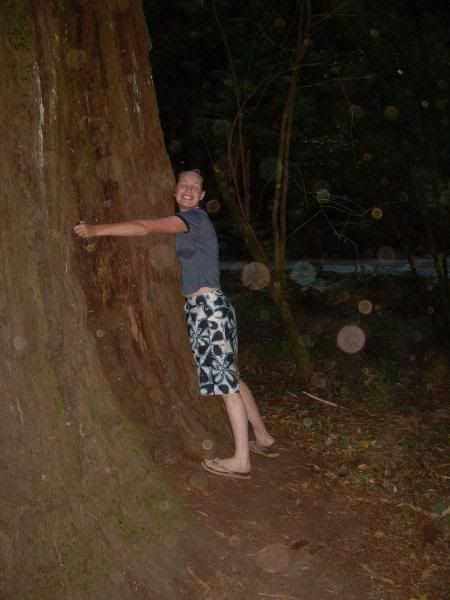
Happy Earth Day!

[Image description: A young white woman with brown hair (this blog's author) 
wearing white and blue swimming shorts, flip flops and a blue t-shirt 
hugs a large redwood tree and smiles broadly with her eyes closed. 
Small round specks sort of like bubbles dot the photo 
where a light mist had covered the camera lens.]

Hug a tree, it's good for you! :)

Friday, April 01, 2011

We Are One: April 4 Day of Action

From the site: "On April 4, 1968, Dr. Martin Luther King Jr. was assassinated in Memphis, where he had gone to stand with sanitation workers demanding their dream: The right to bargain collectively for a voice at work and a better life. The workers were trying to form a union with AFSCME.

Beginning with worship services over the April 1 weekend, and continuing through the week of April 4, unions, people of faith, civil and human rights activists, students and other progressive allies will host a range of community- and workplace-focused actions.

Join us in solidarity with working people in Wisconsin, Ohio, Indiana and dozens of other states where well-funded, right-wing corporate politicians are trying to take away the rights Dr. King gave his life for: the freedom to bargain, to vote, to afford a college education and justice for all workers, immigrant and native-born. It’s a day to show movement. Teach-ins. Vigils. Faith events. A day to be creative, but clear:


See the link for your local action!!

List of Bay Area events current as of April 1 below the cut:

Monday, August 16, 2010

Chronicles of New Bath Stuff Part 1

So... In honor of my just past birthday (and the fact that our shampoo and soap bottles were about to start farting...) I got a bunch of new bath stuff off of Etsy!  And this has been something that has taken up quite a bit of my time lately, switching entirely (not for the first time, but hopefully the last time) to natural (aka not synthetic) body care products.  This is part of the same process that has been going on for at least 8 years, such as stopping shaving, learning how to use herbs instead of OTC or prescriptions, etc (better for me and better for the environment, win/win)...

And I plan to chronicle my thoughts about these in pursuit of having a good idea of how I like these!  And I share them here because I think perhaps maybe this will be useful or it will create a discussion with others for whom this is a shared interest.

So, anyway I wrote what follows when I got the first packages...  One is from a seller who does botanical salves and stuff for lots of different medicinal needs, and the other from a lady who does soaps, perfumes and shampoo bars, etc.  She also does a "for everything" herbal salve (burns, scrapes, cuts, stings, rashes, etc.) and I had to get rid of the other one I had because the oils in the one I had went rancid, so I'm trying hers instead!  Atm I have it on the remnants of a burn I got splashing boiling water/oil onto my stomach! (don't ask)

Anyway, ok, so I just took a shower and tried one of the shampoo bars I got from her, the beer and egg bar.  It's, a little weird!  Rinsing my hair out, I felt like there was a lot of STUFF left behind.  Like, have you ever used straight up shea butter?  You know that coating it leaves on your hands while it soaks in?  Like that, it felt exactly like that.  Which, she has shea butter in the bar (I think) so you know that might make sense (double checked, no, no shea in this bar, but there is cocoa and mango butters so that's probably it).  But still, it was a little weird and will take getting used to.  Thankfully she did warn that it would be different from using other shampoos so I wasn't freaking out.

Among other things she also advises using a vinegar rinse every 3 or 4 times you shampoo (I'm guessing these have more buildup than other shampoos?) to keep your hair healthy.  She gave instructions on how that works too but I did a bit of Googling for myself and ended up with an apple cider vinegar rinse with warm water and two drops of rosemary essential oil and one of patchouli essential oil.  Rosemary is apparently good for dark hair and patchouli is good for dandruff and dry scalp (also they both smell good).  Read the link if you want to know why vinegar is good for your hair, but apparently it really is and I should have been doing this already!

I also tried one of her body soaps and one of her face soaps (samples she gave me) the face soap I really like, it was a white clay soap (but I didn't FEEL any clay bits) and my face feels really soft now.  The body soap was ok, I wasn't super crazy about the smell and it did that thing so many bar soaps do where it left my skin "squeaky" which I find weird.  However, the lather did feel really creamy and my skin didn't feel dry when I got out of the shower so that's good.

We'll see what I think of this shampoo when my hair dries (oh and you will notice no conditioner needed, apparently this is also a benefit of a vinegar rinse and this kind of shampoo; interesting).

In other news, I bought an herb plant at Trader Joe's!  It was a little pot with oregano, sage and spearmint in it, which our neighbor helped me transfer into a bigger pot, which the plants all seemed like quite a bit.  And I've had them about two weeks and they're not dead yet!  It's like magic!

*LATER THAT DAY*

When my hair came out of the towel, still damp as it always is cuz I have a ton of it, it was easy to comb through and easily put up or, as I decided to go with it, in two braids.  It does feel soft and it does look shiny, let's see if this keeps up!

Oh also my hair smells faintly of rosemary (and fainter still of patchouli) and at no time smelled like vinegar, so, that's a win.

Wednesday, April 14, 2010

Listening to the natural world...

An incredibly important idea for Westerners to take to heart!
The other difference I want to mention—and essentially every traditional indigenous person with whom I have ever spoken has said that it is the fundamental difference between western and indigenous peoples—is that even the most open Westerners view listening to the natural world as a metaphor, as opposed to something real. I asked American Indian writer Vine Deloria about this, and he said, “I think the primary thing is that Indians experience and relate to a living universe, whereas Western people, especially science, reduce things to objects, whether they’re living or not. The implications of this are immense. If you see the world around you as made up of objects for you to manipulate and exploit, not only is it inevitable that you will destroy the world by attempting to control it, but perceiving the world as lifeless robs you of the richness, beauty, and wisdom of participating in the larger pattern of life.” That brings to mind a great line by a Canadian lumberman: “When I look at trees I see dollar bills.” If when you look at trees, you see dollar bills, you’ll treat them one way. If when you look at trees, you see trees, you’ll treat them differently. If when you look at this particular tree you see this particular tree, you’ll treat it differently still. The same is true for salmon, and, of course, for women: if when I look at women I see objects, I’m going to treat them one way. If when I look at women I see women, I’ll treat them differently. And if when I look at this particular woman I see this particular woman, I’ll treat her differently still.

Here’s where people usually ask, “Okay, so how do I listen to the natural world?” When people ask me this, I always begin by asking them if they have ever made love. If so, I ask whether the other person always had to say, “put this here,” or “do that now,” or did they sometimes read their lover’s body, listen to the unspoken language of the flesh? Having established that one can communicate without words, I then ask if they have ever had any nonhuman friends (a.k.a. pets). If so, how did the dog or cat let you know that her food dish was empty? I used to have a dog friend who would look at me, look at the food dish, look at me, look at the food dish, until finally the message would get across to me.

How do we hear the rest of the natural world? Unsurprisingly enough, the answer is: by listening. That’s not easy, given that we have been told for several thousand years that these others are silent. But the fact that we cannot easily hear them doesn’t mean they aren’t speaking, and does not mean they have nothing to say. I’ve had people respond to my suggestion that they listen to the natural world by going outside for five minutes and then returning to say they didn’t hear anything. But how can you expect to learn any new language (remember, most nonhumans don’t speak English) in such a short time? Learning to listen to our nonhuman neighbors takes effort, humility, and patience.

(via Fierce...Flawless...) (Read the whole article HERE)

Sunday, March 14, 2010

"Developed" land is not better land

Indians: Vallejo's plans for park desecration
"Plans by [the city of] Vallejo to turn a scraggly stretch of waterfront on the Carquinez Strait into a park with paved parking, trails and restrooms are infuriating local Ohlone Indians who say the 15-acre site is sacred and should be left alone.

The property is Glen Cove Park, a spot that was the site of a 3,500-year-old Ohlone village and shell mound where thousands of people were buried.

The settlement is one of the oldest Ohlone sites in the Bay Area and among the few that has eluded development. But for decades, Vallejo has wanted to convert the wildland to a park with a portion of the Bay Trail, picnic tables and a pastoral array of native plants.

'What we want to do is return it to what it was 100 years ago,' said Steve Pressley, maintenance and development manager for the Greater Vallejo Recreation District. 'As an agency, we have a responsibility to the public as a whole, and we need to consider all the components, not just the needs of Native Americans.'"

Of course, as it noted further along in the article, people already use this site as a park and are quite happy with it. So "responsibility to the public as a whole" is a shallow defense at best. Although, I plan to quote that bit in my letter to them as a reason why they should care what I think of their plans.

I'm not even going to get started on how the way the article is written is clearly meant to create sympathy for the city.

In addition, another story will probably be popping up soon putting Vallejo on the radar of bloggers/social justice minded news readers like you and me (hopefully more on that soon), so I want to make sure to spread the word on this. I can just see them using the noise on the other story to do some shady shit like this while we're distracted.

Please feel free to tell the Greater Vallejo Recreation District and tell them just what you think about paving over sacred Indian locations:

Shane McAffee, General Manager
smcaffee@gvrd.org
Telephone: 707-648-4603

Steve Pressley, Maintenance & Development Manager
spressley@gvrd.org
Telephone: 707-648-4602

Board of Directors
BoardofDirectors@gvrd.org

In their local community workshops [pdf] the GVRD asked participants to rank a selection of priorities, one being "Protect Native American sacred land." I think that should be number one. How about you?

Friday, December 05, 2008

We all live in Bhopal

Remembering Bhopal: 24 Years ago Wednesday


Clearly I need to watch more History channel, as I didn't know about this. What a horrific piece of history.

Sunday, August 31, 2008

It Might Be Happening Again

As I'm sure you've already read, Hurricane Gustav appears to be heading for New Orleans, right on the heels of the Katrina anniversary.

There is much you can do and better people than me pointing out where to spend your money (and please do, even if it's only five bucks).

BlackAmazon: INCITE! RIGHT NOW (I did)
brownfemipower: Critical Resistance
Slyvia: has a ton of links on how you can help
los anjalis: Gustav Information Network
Nezua: is on it as always
Kristin: gives us more than a few resources

And many others are keeping up to date on what's happening.
Kate Harding: selections from The CNN article on Gustav
David: why you don't pray ill to befall people
Professor Black Woman: gives us details
Bint: asks us to keep her family in our prayers


I will keep you up to date as I read more.

*edit* Infoshop will be blogging along with whatever happens as they can

Saturday, August 02, 2008

Prevent Animal Cruelty - Yes on Prop 2

Major h/t to bfp for this one.

Who is Californians for Humane Farms?
Californians for Humane Farms is sponsored by the Humane Society of the United States, Farm Sanctuary and other animal protection groups, family farmers, veterinarians, and public health professionals, who have joined together in an effort to launch a statewide initiative for the November 2008 ballot—one that will improve the lives of millions of farm animals in California.

What will this measure do?
The Prevention of Farm Animal Cruelty Act provides the most basic protection to farm animals: merely allowing them to turn around and extend their limbs. It's hard to imagine a more moderate initiative. The purpose of the measure is to prevent three of the most cruel and inhumane forms of extreme confinement in the world of animal agribusiness: veal crates, battery cages, and gestation crates. All three of these practices have already been legislated against in the European Union.

Why launch this initiative in California?
The Prevention of Farm Animal Cruelty Act will reduce the suffering of nearly 20 million animals confined on California factory farms. The measure will also prevent other out-of-state factory farm operators from setting up shop in our state with veal crates, battery cages, and gestation crates.

Will this initiative put farmers out of business?
This measure targets large factory farms that have displaced smaller, independent family farms. Not only will this effort prevent animal cruelty, it can help protect small farmers from massive animal factories. Furthermore, producers will have six years—until 2015—to phase out these cruelest confinement practices, allowing ample time for the transition.

How do these factory farms affect public health?
The tolls factory farms exact on public health are well-documented. In 2003, the American Public Health Association passed a resolution urging officials nationwide to adopt a moratorium on factory farms. Studies have found that neighbors report more frequent occurrences of headaches, excessive coughing, diarrhea, and burning eyes as well as respiratory problems, weakness, and nausea. Furthermore, recent studies have found that children who attend schools near factory farms suffer increased incidences of asthma.

Will food prices increase if this initiative passes?
Published research as well as an analysis by a California-based poultry economist (see page 4) show that it costs producers less than one additional penny per egg not to confine laying hens in battery cages. While it's possible that giving these animals better living conditions may increase consumer prices by a few pennies per dozen, the hidden cost of such inhumane confinement is increased cruelty, and it's the animals who are paying that extra price.

How can I help?
Visit www.humanecalifornia.org for more information on how to support this historic initiative. Contact director@humanecalifornia.org for more information on how to help, including door-to-door canvassing, securing campaign endorsements, fundraising, etc. And of course, vote YES on the Prevention of Farm Animal Cruelty Act on November 4, 2008!


Californians for Humane Farms
Post Office Box 418202
Sacramento, CA 95841-8202
(323) 896-1126
director@humanecalifornia.org


Vote Yes on Prop 2 in November!!

Friday, March 14, 2008

Bravery

All I can say is "wow" to the bravery of these folks. My heart is with them.

As bulldozers and chainsaws cut into the forest and hill of Rath Lugh - one of a number of ancient tombs and holy wells in peril due to the road work in the Tara-Skryne Valley - protesters have announced that they have dug tunnels under the proposed roadway, and are willing to risk their lives in defense of the land.

For months now our brave pixies have been digging in secret, carrying out buckets of earth under cover of night. They have stocked the tunnels with food and supplies, and are digging in for at least a three month stay.

The soil around Rath Lugh is loose stone and esker. If the road crew attempt to drive their heavy machinery over the land, the tunnels will collapse. One of the women, interviewed in the video below, explains that if the gardaí attempt to enter the tunnel, she will lock herself to the jack holding up the roof. If they then attempt to pull her out, the tunnel will most likely collapse on them all. The question is, will those who are pushing this illegal roadway through, despite the protection orders and 80 percent public disapproval in Ireland alone, have the guts to refuse to harm these human shields, or are they going to have more Rachel Corries on their heads?

Wednesday, January 09, 2008

News stories of interest

The first feminist book store in Turkey

Amargi takes its name from a Sumerian word meaning freedom and "returning to mother." It aims to unite the experiences of women and academia and to develop feminist analysis and policies at the same time.

"We develop feminist thought and feminist policies through an analysis of current problems and through the organization of seminars and workshops, and by publishing books," Selek said, emphasizing that Amargi has been active in politics as a cooperative for seven years. In addition to the quarterly Amargi journal that has been published for the past two years, the feminist bookstore is both the outcome and the driving force of the organization's efforts.


Such an encouraging step for this country. This is exactly what I have been hoping to see out of the dominantly Muslim countries. I really hope that western feminist will lend their support however they can to this venture.

Gloria Steinem's NY Times editorial from earlier this week.

THE woman in question became a lawyer after some years as a community organizer, married a corporate lawyer and is the mother of two little girls, ages 9 and 6. Herself the daughter of a white American mother and a black African father — in this race-conscious country, she is considered black — she served as a state legislator for eight years, and became an inspirational voice for national unity.

Be honest: Do you think this is the biography of someone who could be elected to the United States Senate? After less than one term there, do you believe she could be a viable candidate to head the most powerful nation on earth?


She's got a point. But there are also some problems with her conclusion.

Via NY Times, how poor, non-white people's diseases simply don't attract the funds of others.

“Sleeping sickness” is too benign a nickname for human African trypanosomiasis, which is caused by a protozoan spread by biting tsetse flies. When the parasites enter the brain, victims hallucinate wildly. They have been known to chase neighbors with machetes, throw themselves into latrines and scream with pain at the touch of water. Only at the end do they lapse into a lassitude so great that they cannot eat, followed by coma and death.

About 150,000 people contract the disease each year, but 50 million people in 36 countries live in areas where they are at risk.
[...]
After critics accused Sanofi-Aventis of catering to vain rich women while letting poor Africans die, the company agreed to make an injectable form of the drug and now gives it free to the World Health Organization and Doctors Without Borders.

But in rural Africa, eflornithine is very hard to use. Patients need intravenous infusions four times a day for two weeks. When a “hospital” is a row of iron beds under a thatched roof, and the “nursing staff” is mostly relatives of the sick who sleep on the floor, round-the-clock treatment is hard. There might be no night nurse to insert an IV line.


It really is sad how situations like this continue to exist. Especially alongside people trying to claim racism and classism don't exist anymore.

A cool new MOMA exhibit: Prefab Housing

To many people the term “prefab housing” calls to mind trailer parks. Yet lately prefabricated houses — built off site and then delivered largely complete — have become fashionable at architecture schools and among an upscale segment of the housing market. They pose a considerable design challenge.

Seizing the moment the Museum of Modern Art has commissioned five architects to erect their own prefab dwellings in a vacant lot on West 53rd Street, adjacent to the museum. Whittled down from a pool of about 400, the five architects are participating in “Home Delivery: Fabricating the Modern Dwelling,” an exhibition opening in July.


This is really exciting! Pre-fab housing has the potential to make house building in general so much more eco-friendly. I was reading about them in Dwell magazine's recent "Green Issue" and the possibilities really seem endless, if only we can get people interested in them.

Friday, December 14, 2007

Diva Cup reviewed

Yes!!

Feminist Review has acknowledged the awesome that is the menstrual cup (in it's Diva incarnation)!

I've used one of these for about a year and a half now, and I would never, EVER go back.

Couple this plug with the recent post from Samhita about DIY menstrual products which included Jessica Valenti's comment that she loves her Diva as well (I guess it's gone well since her initial questions about it) and I'd say cups are getting some very decent exposure of late. I can only hope that the commercials are not too far off, these things would change so many women's menstrual lives it's not even funny. Not to mention the positive impact on the environment!

Tuesday, December 04, 2007

My end of week wrap up...

The New York Times
December 2, 2007
San Francisco Fleet Is All Biodiesel
By CAROLYN MARSHALL

SAN FRANCISCO, Nov. 30 — Claiming it now has the largest green fleet in the nation, the city of San Francisco this week completed a yearlong project to convert its entire array of diesel vehicles — from ambulances to street sweepers — to biodiesel, a clean-burning and renewable fuel that holds promise for helping to reduce greenhouse gases.

Using virgin soy oil bought from producers in the Midwest, officials said that as of Friday, all of the city’s 1,500 diesel vehicles were powered with the environmentally friendlier fuel, intended to sharply reduce toxic diesel exhaust linked to a higher risk of asthma and premature death.


As many stories that I love coming out of SF lately, I think I need to add a new tag...

I have a LOT of stories that have piled up over the last week thanks to work. Among other things; Chevron's actions in Ecuador, a Q&A with Hillary Clinton from Our Bodies, Our Blog, welfare costs being deducted from child support payments, the case of an Oklahoma woman being charged with First Degree Murder for the stillbirth of her child supposedly due to drug use from BFP, and Katherine Heigl's comments about Knocked Up, the movie she starred in, being sexist.

Honest to gods, so many comments, so little fucking time. I will probably start with the Knocked Up story, only because I've already got some commentary stored up via the discussion happening right now about it at Feministing. But the most important ones are the story from BFP and the story on Chevron in Ecuador, so please go check those out!